A toilet that gurgles, a floor drain that bubbles and a tub that fills with gray water all point to one question: where is the blockage? In Kingston the answer depends on whether the house is on the town sewer or its own septic system.
Key takeaways
- Only part of Kingston is on the municipal sewer, and the town publishes a Map of Sewered Areas that shows which parts.
- A backup that affects several fixtures at once points to the main drain, the septic tank or the town sewer, not one clogged fixture.
- Kingston Sewer Commission and Wastewater Department pages offer grinder pump information and a Do Not Flush information.
- Sewage is Category 3 water, so porous materials it touched are removed and hard surfaces are cleaned and treated.
- Cleanup and the plumbing repair are separate jobs and are often done by different people.
Two systems, one symptom
Kingston is a coastal town on Kingston Bay with a mix of neighborhoods. Some are connected to the municipal sewer, and the rest use private septic systems.
From inside the house the first signs look the same. The difference shows up when someone asks who fixes the cause.
How to find out which system a house uses
The town publishes a Map of Sewered Areas on its sewer page. Compare it with the property, and check the closing papers or past septic pumping receipts if the map does not settle it.
If the house has a septic tank, a septic pumper may know the system better than anyone else.
The town side of the system
Wastewater service is run by the Kingston Sewer Commission and Wastewater Department, with three elected commissioners. The sewer page also lists grinder pump information, a Do Not Flush information and a news flash titled Riverside Pump Station Issue.
Those pages are a good first stop for any homeowner who suspects a problem on the town side.
Signs the problem is the town sewer
A backup that starts at the lowest fixture in the house and hits several drains at once can point past the property. Neighbors may be seeing the same thing.
- Floor drains and the lowest toilet back up when nothing else was running.
- Water rises in a shower or tub when someone flushes or runs a washer.
- A neighbor has the same trouble at the same time.
- The home has a grinder pump and its alarm is sounding or a breaker has tripped.
- The Sewer Commission has posted a notice about a pump station or a repair.
Signs the problem is a private septic system
Septic trouble tends to build slowly and then arrive all at once. Heavy use or heavy rain can tip a tank or drain field over the edge.
- Slow drains throughout the house, then a backup in the lowest fixture.
- Gurgling in pipes when water runs elsewhere.
- Soggy ground, a strong smell or lush grass over the tank or the drain field.
- A backup after a stretch of heavy laundry, a houseful of guests or a very wet week.
- Alarm lights on an advanced system, if the home has one.
What to do before anyone arrives
Sewage is a health hazard from the first moment. The first steps keep people safe and keep the water from spreading.
- Stop using water. No flushing, no showers, no washer or dishwasher.
- Keep children, pets and anyone with a weak immune system out of the room.
- Turn off power to the affected area if water is near outlets or equipment and it is safe to reach the panel.
- Wear boots, gloves and a mask if you must enter, and do not touch the water with bare skin.
- Do not try to clean it with a household vacuum, mop or bleach and a sponge.
- Photograph the backup, the fixtures and the damage before anything moves.
Who gets the call
Two calls usually go out. One goes to whoever fixes the pipe or the tank, and the other goes to the crew that cleans the house.
The order depends on the system.
If the house is on the town sewer
Call the Kingston Sewer Commission and Wastewater Department to report the problem and find out whether there is an issue in the street. A plumber can then check whether the blockage is in the house pipe or beyond it.
This post does not say who owns which part of the pipe, because that depends on the property and should be confirmed with the town.
If the house is on septic
Call a septic pumper, who can pump the tank and tell whether the drain field is failing. Ask the pumper what inspection or repair the tank and drain field need.
How a sewage backup is cleaned
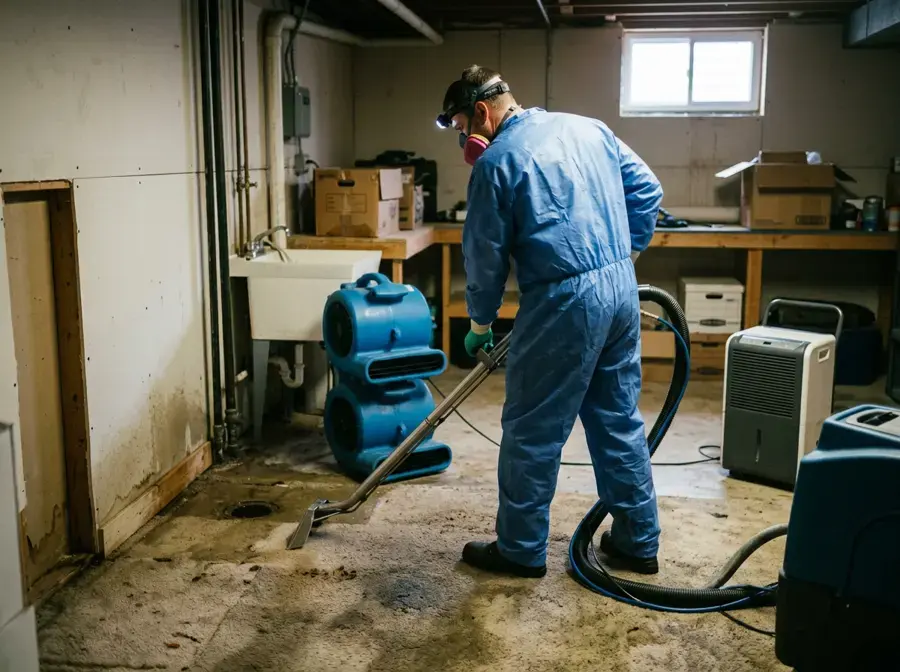
A restoration crew works to a strict routine. The aim is to remove what soaked, clean what did not and leave the area safe.
This work is described on the sewage backup cleanup page for Kingston and in the main sewage and septic backup cleanup page.
Containment and removal
The crew sets up barriers so the rest of the house stays clean, then pumps or extracts the liquid. Water extraction comes first, because the longer it sits, the deeper it goes.
- Carpet, pad and wet insulation are removed.
- Drywall and baseboard that soaked up the water are cut out.
- Mattresses, upholstered furniture and stored boxes that touched it are usually discarded.
- Hard surfaces are scrubbed and treated with an antimicrobial.
Air and drying
HEPA air scrubbers clean the air while the crew works. After cleaning, air movers and dehumidifiers dry the space until readings are normal.
Insurance and the plumbing repair
Sewer backup is often a separate coverage from other water damage. Ask your own insurer what the policy says before the work starts, and keep every receipt.
A plumber, septic contractor or the town repairs the cause. The restoration crew cleans up after it, and the two jobs are billed separately.
Keeping it from happening again
Follow the town's Do Not Flush information. Wipes, grease and paper towels are common culprits in a blocked pipe.
If the home has a grinder pump, learn where the alarm and the breaker are. The Kingston hub lists the other water services nearby.
Questions
How can a Kingston homeowner tell if the house is on the sewer or septic?
Check the town's Map of Sewered Areas on the sewer page. If the house is outside the mapped area, it is probably on septic. Past pumping receipts or closing papers can confirm.
Who should be called first for a sewage backup in Kingston?
Stop using water first. Then call the Sewer Commission if the house is on town sewer, or a septic pumper if it uses a tank, and call a restoration crew to clean up the spill.
Is sewage water dangerous to touch?
Yes. It is treated as Category 3 water and can carry bacteria and viruses. Keep people and pets away, and wear boots and gloves if you must go in.
Can carpet touched by a sewage backup be saved?
Usually not. Carpet, pad and other porous materials that touched sewage are removed, because they cannot be cleaned to a safe standard.
Does insurance cover sewage backup?
Sometimes, and often as a separate coverage. Read the policy and ask your own insurer before work begins.