Structural Drying and Dehumidification in Duxbury, MA
Damp bay air slows drying in Duxbury, so a fan alone rarely finishes a wet house. The drying team sizes dehumidifiers and air movers to the class of loss and runs them until framing and subfloor read dry.
(888) 480-6221Start the structural dry-out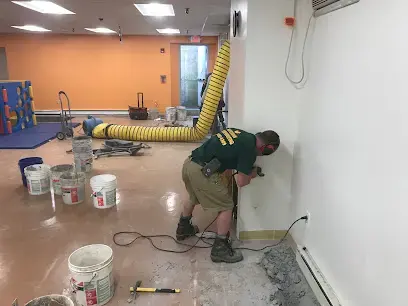
Structural Drying and Dehumidification at a glance
First steps for structural drying and dehumidification in Duxbury
- 1
Close the windows
Keep the house closed so dehumidifiers control the air.
- 2
Leave machines running
Do not switch the equipment off.
- 3
Keep doors open inside
Open interior doors and closets for air flow.
- 4
Do not seal wet walls
Wait for dry readings before paint or flooring.
How structural drying and dehumidification works in Duxbury
Drying is a measured process, and the measurements start with the materials. Hardwood, plaster, masonry and timber framing hold water differently, so the class of loss and the weather inside the house decide how many machines run and for how long.
What does structural drying and dehumidification cost in Duxbury, MA?
In Duxbury, MA, structural drying usually costs $1,500 to $12,000. One or two rooms sit near the low end, while Class 4 materials like hardwood, plaster or concrete sit near the top because they need more equipment and time.
One or two rooms
$1,500 to $4,000- Air movers
- LGR dehumidifier
- Daily readings
Several rooms or a level
$4,000 to $8,000- Cavity drying
- Psychrometric logs
- Claim documentation
Class 4 materials
$8,000 to $12,000- Desiccant drying
- Hardwood drying mats
- Extended monitoring
Ranges are typical, not a quote: category of water, square footage, material class and how fast drying started move the number most. Run the water damage cost calculator for a closer range.
The structural drying and dehumidification process, stop by stop
The tech who does the walkthrough maps moisture before any equipment goes down, so the drying plan matches what is actually wet. Equipment stays until the readings say dry, not until the room looks dry.
- 1
Map and class
Meters and a camera define wet areas and class.
- 2
Set the equipment
Machines go in by the load.
- 3
Read each day
Psychrometric logs and readings are recorded.
- 4
Finish and pull
Equipment leaves when readings reach the goal.
Why bay air matters
Duxbury Bay, Kingston Bay and Cape Cod Bay keep outdoor humidity high, and older timber-framed homes hold moisture in their framing and subfloor. Opening windows rarely helps, so a closed, dehumidified space gives the drying team control. Photos of the logs go in the claim file.
- Closed, dehumidified space instead of open windows.
- Temperature and humidity logged each visit.
Equipment sized to the class
Class 1 losses touch little material, while Class 4 losses involve dense materials like hardwood, plaster and concrete that need desiccant units and drying mats. The drying team sizes air movers for the wet surface and dehumidifiers for the room's evaporation load.
- Air movers matched to wet surfaces.
- LGR dehumidifiers for the room load.
- Desiccant units and mats for dense materials.
When the drying is done
Dry is a number, not a feeling: each material must read near an unaffected reference spot in the house. The drying team checks framing, subfloor and wall bottoms each day, adjusts the equipment and removes it only when every reading reaches the goal. After a flood, see storm flood cleanup, and for standing water, water extraction.
- Daily readings in framing and subfloor.
- Equipment adjusted as areas dry.
Structural drying and dehumidification across Duxbury and nearby towns
Drying work covers ZIPs 02332 and 02331, from Powder Point, Snug Harbor and Standish Shore to Hall's Corner, Millbrook, Cox Corner, Island Creek and Duxbury Beach.
The same service nearby: structural drying and dehumidification in Plymouth, Marshfield, Kingston.
Related water damage services in Duxbury
Structural Drying and Dehumidification questions in Duxbury, MA
Why not just run a fan?
A fan moves air but removes no moisture. Dehumidifiers pull water from the air so wet framing and subfloor can release theirs.
What are the four classes of loss?
Class 1 touches little material, Class 2 wets a whole room, Class 3 soaks from above, and Class 4 involves dense materials like hardwood and plaster.
How long will the equipment stay?
As long as readings need. Many jobs run three to five days, and Class 4 materials or damp weather can add days.
Do the machines use a lot of power?
They draw real power, but stopping early on a guess risks wet framing. The daily logs show when the work is done.
Can hardwood floors be saved?
Often, if drying starts early. Drying mats and desiccant units pull water from boards, and cupping can settle as the readings fall.
Does insurance pay for drying equipment?
Equipment time is normally part of a covered water claim, and the daily logs support it. Ask your own insurer what applies to your policy.
Still dealing with structural drying and dehumidification?
Shut off the water at the source if it is safe, keep clear of wet outlets, then call.
Dry the structure, not just the surface.
Moisture left in framing and subfloor causes trouble long after the water is gone. The drying team sizes the equipment and runs it until readings prove the structure is dry.
(888) 480-6221Call for Duxbury structural drying- Dispatch around the clock, storm nights included
- Drying held to the IICRC S500 standard
- Daily moisture logs for the claim file
- Find us on Google